|
The Landlord Database: What's Actually Happening
|
|
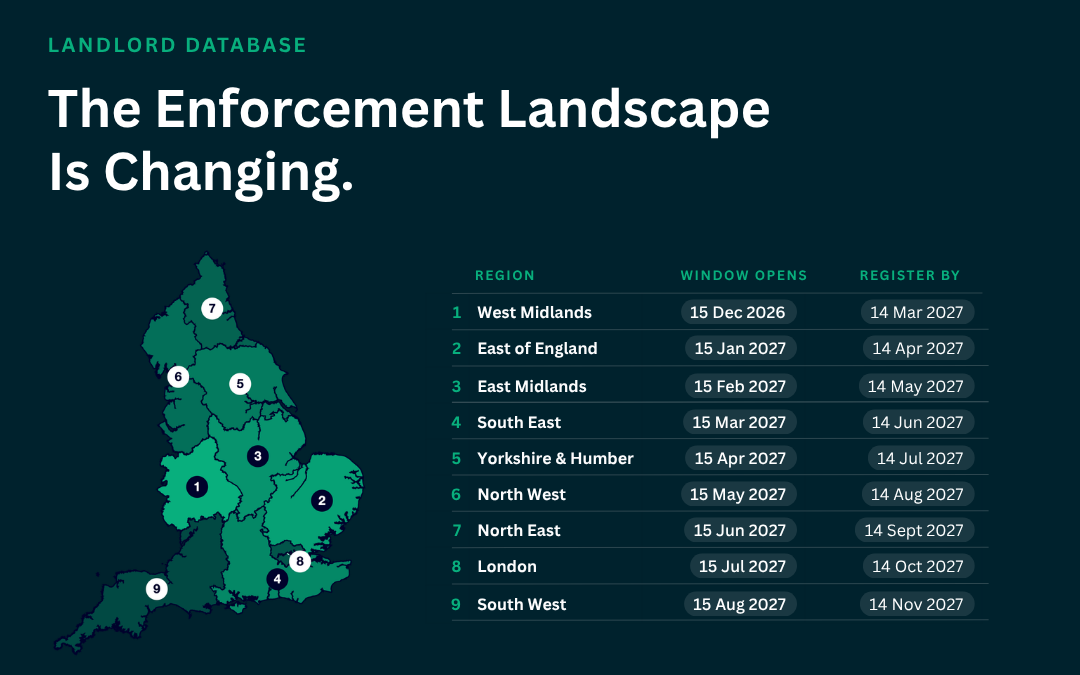
The Landlord Database now has a confirmed timetable. Rollout begins on 15th December 2026 in the West Midlands, then moves region by region over the following year, with each region getting a three-month window to register once it opens.
|
|
Every private landlord in England with an assured or regulated tenancy will need to register, at a cost of £65 per property per year, renewable annually. Landlords who don't could face civil penalties of up to £7,000, rising to £40,000 for repeated or multiple breaches. At this stage, empty properties being marketed to let don't need to be registered, though that's expected to change once a registration number becomes a requirement for advertising.
|
|
Landlords must register themselves; agents can't do it on their behalf directly. What they can do, where the landlord agrees, is provide some of the required information for them.
|
|
Alongside this, the Property Agent Checker (PAC) is set to be linked to the database, initially on a three-year agreement, giving tenants, landlords and regulators a joined-up way to check an agent's standing in one place.
|
| Region |
Window Opens |
Deadline to Register |
| West Midlands |
15 December 2026 |
14 March 2027 |
| East of England |
15 January 2027 |
14 April 2027 |
| East Midlands |
15 February 2027 |
14 May 2027 |
| South East |
15 March 2027 |
14 June 2027 |
| Yorkshire and Humber |
15 April 2027 |
14 July 2027 |
| North West |
15 May 2027 |
14 August 2027 |
| North East |
15 June 2027 |
14 September 2027 |
| London |
15 July 2027 |
14 October 2027 |
| South West |
15 August 2027 |
14 November 2027 |
|
|
How Agents Can Support Landlords
|
|
While registration itself is the landlord's responsibility, there's a real opportunity for agents to add value here. Landlords will be able to agree for their agent or property manager to submit certain information on their behalf, so it's worth getting ahead of this now rather than scrambling when a region's window opens.
|
|
In practice, that means reviewing the records held for managed properties: gas safety certificates, EICR/EIC reports, EPCs, licensing details (including HMO status), and current tenancy information. For landlords with larger portfolios especially, this could otherwise mean a significant manual burden. Agents who get their compliance records in order now, and make sure landlord clients understand their registration deadline, will be well placed to support them when the time comes.
|
|
There are still some open questions the industry wants answered before rollout reaches every region: exactly how agents will be able to support landlords in practice, and whether the process will integrate with the systems agents already use rather than relying on manual input. Privacy is another live topic, with landlords wanting clarity on what information will be visible to tenants versus the wider public.
|
|
More Data Sharing, More Scrutiny
|
|
The Landlord Database isn't the only new flow of information taking shape. A PRS Landlord Ombudsman is also being introduced, and the government has openly admitted it hasn't yet decided whether, or in what circumstances, the Ombudsman will be required to share evidence of landlord non-compliance with local authorities. That's still being worked through, alongside decisions on exactly what data tenants will be able to see on the register itself.
|
|
This isn't unprecedented territory, though. Property agent redress schemes, membership of which is already compulsory, are obliged under a memorandum of understanding to notify National Trading Standards when a member leaves a scheme, or when a serious breach of the law or regulations becomes known. Local authorities and police can also request information from redress schemes under data protection law.
|
|
The direction of travel is clear: more of these bodies are being connected up and less is falling through the cracks between them. Getting the detail right on privacy, proportionality and who sees what will matter, but the overall trend is toward greater visibility of who's operating properly and who isn't.
|
|
The Scale of the Problem
|
|
It's easy to think of compliance failures as a paperwork issue. They're not. According to National Trading Standards, more than £125 million in estate agent detriment has been identified since 2020 alone, some of it within lettings, and that figure only reflects the cases they've personally handled. The true national total, across the wider sector, is almost certainly far higher.
|
|
Most of these cases follow a similar pattern: a trusted employee within an agency exploiting weak financial controls for personal gain, often for years before anyone notices.
|
|
New Powers, More Targeted Enforcement
|
|
The Renters' Rights Act is already reshaping how enforcement works on the ground. Housing teams across England are being handed new powers to move from a reactive, inspection-led approach towards genuine, targeted investigative enforcement. For landlords and agents who are trying to do things properly, that's good news. It levels the playing field against those who aren't, and there's real momentum behind getting more of these cases dealt with properly.
|
|
It's Already Happening
|
|
These aren't hypothetical risks. Lee Clarke, director of Berkshire Estate Agents in Slough, was jailed for three years in 2021 after defrauding 31 clients, landlords and tenants, of more than £182,000 by collecting rent and failing to pass it on. He was also disqualified from acting as a company director for six years. It's a stark reminder that client money handling failures aren't abstract compliance risk, they're a direct threat to landlords' livelihoods and an agency's reputation.
|
|
Where This Leaves You
|
|
If you're already working with TLP Assured, you're ahead of the curve. Independent verification of your client money handling, through our CMP HealthCheck and Outsourced Client Accounting, gives you and your landlords real confidence that your business isn't the next headline.
|
|
If you'd like to talk about how TLP Assured can support your business as scrutiny increases, get in touch below, we'll be happy to help.
|
|